Title searches, commitment prep, and closing coordination — without the manual grind.
Automated workflows that handle the repetitive work in title and escrow operations, so your team can focus on exceptions and client service.
Data entry is where the hours go first. Start there.
Most agencies we talk to don’t begin with curative — they begin with the keyboard.
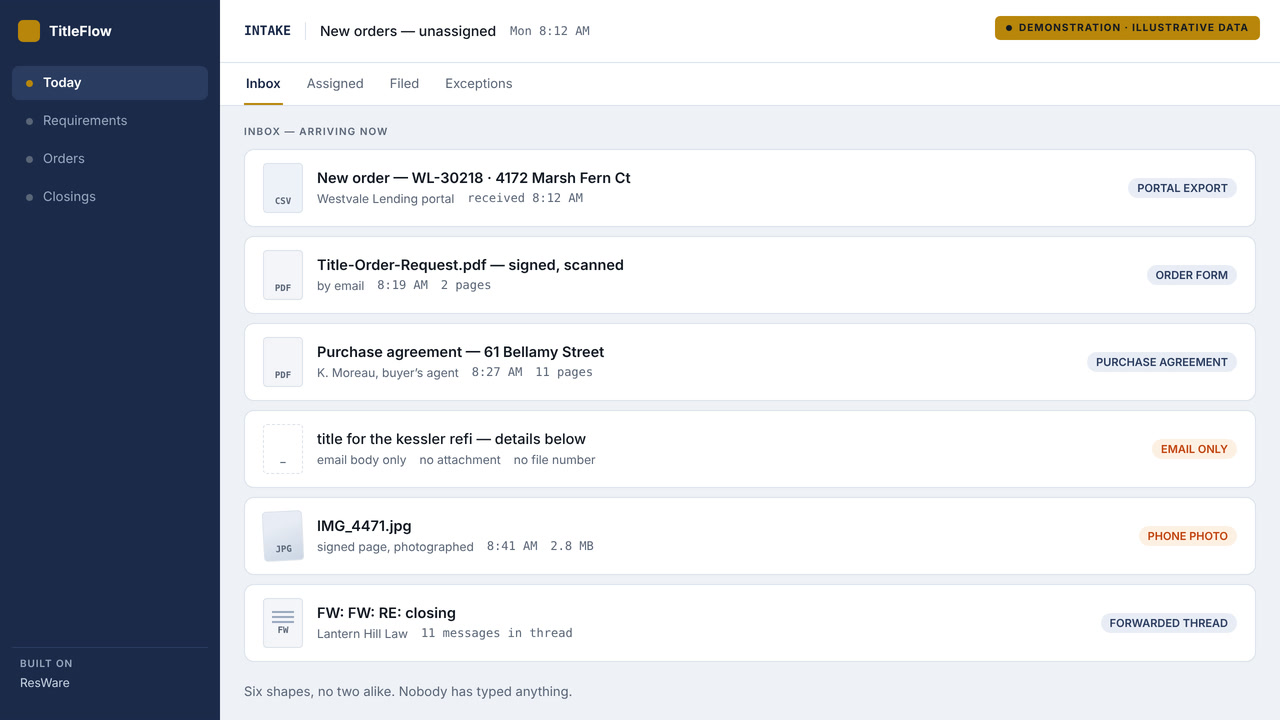
Walk into the operations room of almost any title agency and the first job you’ll see isn’t title work — it’s typing. Orders arrive all day from a rotating set of lenders, realtors, and firms, and no two format a request the same way: a portal export, an emailed order form, a purchase agreement, a scanned signature page, a forwarded thread — sometimes just details typed into the body of an email with no attachment at all, and a meaningful share with no usable file number anywhere in them. Somebody reads every one. Somebody keys every one into the TPS. On every order, before the real work can start.
TitleFlow starts exactly there. It reads what arrives — however it arrived — matches it to a new or existing order, and writes the file into the title production system you already run: property, parties, lender, amounts, dates, with the documents named and attached. And when a message can’t be read cleanly, or a match isn’t certain, it doesn’t guess — it routes to your staff with candidates and the reasoning attached. The typing goes away. The judgment stays yours.
If your platform ships intake of its own, use it — Qualia’s network can hand an order straight to another Qualia shop, and SoftPro 360 moves work to your vendors and back. The queue this section is about is everything arriving from outside those rails, from parties on no network at all. And what we build writes into your system — ResWare, Qualia, SoftPro, RamQuest, or your TPS — not into a platform of ours.
A demonstration built on illustrative data. No client files, no real people, no results claimed.
Six formats in. One clean file out. Nothing guessed.
Read the transcript
Monday morning. Six new orders.
A portal export. An order form attached to an email.
A purchase agreement. And one with no attachment at all.
A photo of a signed page. A forwarded thread.
Each becomes the same structured file, in the system you already run.
Anything it can’t read cleanly goes to a person — candidates, never guesses.
Start with the free Intake Read.
Read first. Build second. Decided by you.
The first step is the Intake Read, and it is free: send six to ten of your real orders under a mutual NDA — we sign it first — and within five business days you get one findings document back. Where your identifiers actually live. Which orders would match automatically. Which would need a person, and why. Findings come back as assumptions for you to correct, not claims. One Read per company; if what we find isn’t interesting, you keep the document and we part friends.
It is built this way because of where it comes from: WisdomStream’s founder is a Florida attorney who started in title doing data entry and processing, later practiced as a lawyer for a title insurance company, and closed files himself — before building automation for any of it.
You’ll also notice there is no accuracy rate and no time-saving figure anywhere on this page. Vendors in this category publish large numbers with no stated basis; we would rather measure yours. That is what the Read begins.
Under ALTA Best Practices 5.0, a tool like this counts as one of your vendors from the first shared file — so the Read is built diligence-first: the NDA before your orders, and our Pillar 7 answers in writing before anything is built.
Six to ten real orders and an NDA we sign first. One document back within five business days.
Go deeper: how the whole title workflow automates, and where order data begins before the order.
Your team is drowning in coordination work that should run itself.
Every closing requires dozens of documents from multiple parties, all on different timelines. Your team spends hours assembling packages, chasing signatures, tracking deadlines, and sending status updates to agents, lenders, buyers, and sellers. The actual title work takes expertise — the coordination around it doesn't. That's what TitleFlow automates.
How TitleFlow Works
From file opening to recorded deed — every routine coordination step automated.
File received
When a new order comes in, TitleFlow sets up the file, identifies required documents, and begins tracking all deadlines automatically.
Documents assembled
Title commitments, closing packages, and standard forms are assembled automatically from templates. Your team reviews and handles exceptions.
Parties updated
Agents, lenders, buyers, and sellers receive automatic status updates at every milestone. No more "where are we?" calls.
Closing coordinated
Documents staged for signing, deadlines monitored, recording timelines tracked. Your closers focus on the closing, not the logistics.
See how it works
Whichever title production system wins your evaluation, the hours leak in the same place: between the platform and your people. Order intake, document chasing, curative follow-up, status calls, payoff demands — coordination your best people carry by hand, on every file, from open through post-closing.
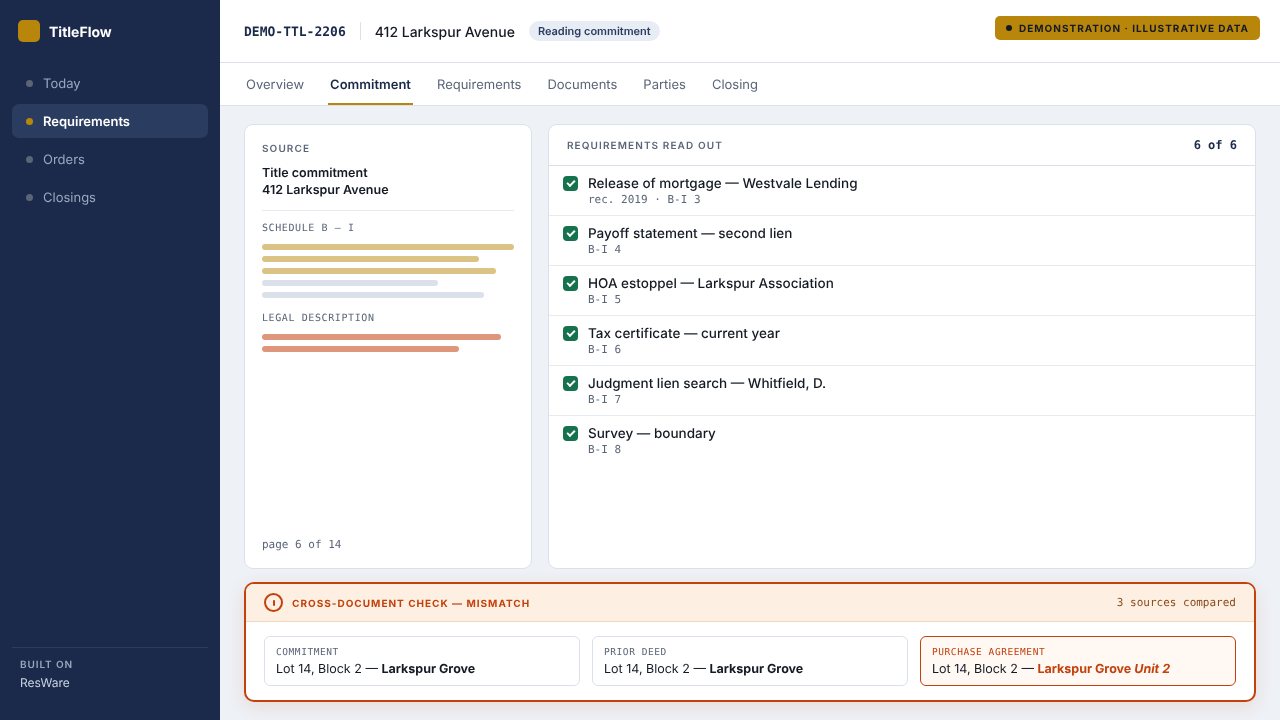
TitleFlow is order intake and curative follow-up, on the TPS you already run. A new order arrives and gets read: the requirements come out of the commitment as a structured checklist. Data lands in your platform’s fields. Documents file themselves. Exceptions route to your staff with the reasoning attached. And every party who needs status gets it the moment the file moves — without a phone call.
The sixty-second walkthrough below shows one order moving through that layer, beat by beat — including the moment that matters most: a payoff that arrives mid-file with changed wire instructions stops in a Review queue and waits for a named person on your staff. The system shows its reasoning and still refuses to decide. Nothing clears itself.
A demonstration built on illustrative data. No client files, no real people, no results claimed.
Orders that move themselves — while your people decide.
Read the transcript
Arrival: A commitment lands — and matches itself to the open order. Nobody clicks anything.
Read: Six requirements come off the commitment — item by item. The legal description is checked across three documents. One disagrees.
File: Two requirements clear themselves from documents already on file. The rest are written into the TPS this agency already runs.
Flag: A revised payoff arrives mid-file — the wire instructions have changed. It stops. The system shows its reasoning — and still refuses to decide. A named person on your staff does.
Status: Every party is updated out of the same pass. Wire instructions stay held until a person logs a callback. TitleFlow drafts. You send.
Board: The board computes the earliest clean close from this file’s own dependencies — and says so before closing week.
Exceptions go to your people. Nothing clears itself.
Nothing in a TitleFlow build decides alone. Documents become structured data; structured data lands in your system of record; and anything uncertain — an ambiguous requirement, a mismatched legal description, a CD figure that doesn’t reconcile, changed payoff or wire instructions — routes to your own staff to adjudicate. Your people stay in command of every judgment call; the system’s job is that they never retype what a machine can read and never miss what a machine can flag.
Every build ships to the same standard, aligned with SOC 2 principles: encryption in transit and at rest · role-based access · multi-factor authentication · audit logging · client data never used to train AI models. Built under the direction of a licensed attorney — the Safeguards Rule was a design input, not a checkbox.
And the first real step is free: an Intake Read under a mutual NDA — a small sample of real orders, read, with findings returned as assumptions for you to correct, not claims — before any system touches anything.
Diligence-ready under ALTA Best Practices 5.0
ALTA Best Practices 5.0 took effect October 8, 2026, and its Pillar 7 asks agencies to apply selection-and-review diligence to the vendors they rely on — AI tools included: where NPI is stored, who can access it, how incidents escalate, what happens if a provider fails. We arrive with those answers in writing — the delivery standard above is the answer sheet. Best Practices is an industry framework, not a statute; we treat it as the shared language of diligence, and we speak it fluently.
Start with the framework itself: ALTA Best Practices 5.0 — what Pillar 7 asks of your vendors →Bring a live order and your pipeline as it actually runs. We’ll walk the mechanism on your own workflow — no pitch-deck theater.
Prefer to start smaller? The Intake Read is free and under NDA — ask for it on the call.
What TitleFlow Automates
Document Automation
Title commitments, closing packages, and standard forms assembled automatically from templates. Consistent formatting, fewer errors, faster turnaround.
Deadline Tracking
Closing dates, contingency deadlines, and recording timelines monitored automatically. Alerts fire before deadlines approach, not after they pass.
Closing Package Assembly
Documents collected from all parties, organized in the correct order, and staged for signing. No manual collation, no missing pages.
Multi-Party Coordination
Automatic updates to agents, lenders, buyers, and sellers at every stage. Everyone stays informed without your team being the bottleneck.
Frequently Asked Questions
Ready to automate the grind out of your title operations?
Book a free strategy call. We'll map your workflow and show you what can run on autopilot.