Key Takeaways
- Title order entry automation turns incoming orders into structured, document-attached files in the title production system an agency already runs — ResWare, Qualia, SoftPro, RamQuest — from portal exports, emailed order forms, purchase agreements, plain-email requests, photographed signature pages, and forwarded threads.
- No two orders arrive alike. Six distinct intake formats are documented across the category’s own vendor materials, and ALTA’s coverage of the space notes that incoming order data is “rarely uniform” in content or format.
- The 2026 vendor field includes Pythonic, Alanna.ai, XtractSol, Areal.ai, MaestroX (OrderAid), Dono.ai, and WisdomStream’s TitleFlow — ours, disclosed as such throughout this guide.
- Published figures in this category are vendor marketing without published methodology — “up to 70%” time savings, “90% hands-free,” a “99% data accuracy target” — while the vendor calling itself the industry’s #1 choice publishes no figures at all.
- Routing an uncertain order to a person instead of guessing is the category norm, not a differentiator. The honest difference between vendors is what the person receives: a bare exception, or candidates with the reasoning attached.
- Under ALTA Best Practices 5.0, an order entry tool counts as one of an agency’s vendors from the moment it touches company data — Pillar 7 diligence applies before the first file is shared.
Title order entry automation is the use of AI document reading and direct title-production-system connections to turn incoming orders — portal exports, emailed order forms, purchase agreements, plain-email requests, photographed signature pages, and forwarded threads — into structured, document-attached files in the TPS an agency already runs, without manual keying. The systems on the receiving end are the familiar ones: ResWare, Qualia, SoftPro, RamQuest, and their peers.
What actually arrives: the six intake formats
Walk the intake queue of a working title agency on a Monday morning and the first thing you notice is that nothing matches. Vendors in this category describe the same reality from their own corners — Pythonic’s product page talks about purchase agreements with “crossed-out words, and handwritten checkboxes” and multi-format email “blobs” buried in forwarded threads; MaestroX built its intake around order instructions copied and pasted from client emails; and ALTA’s write-up of the space says plainly that order data arrives from email, lender technology, and agency portals, and is “rarely uniform” in content or format.
Put the attestations together and six distinct formats account for most of what lands:
| Format | What it looks like | Attested by |
|---|---|---|
| Lender portal export | A structured file or API handoff from Encompass, Black Knight, or a lender’s own portal | XtractSol’s intake list names Encompass and Black Knight by API, with structured email parsing or scheduled export files for portals without one |
| Emailed order form | A blank-form PDF, filled in, signed, sometimes scanned | Title agencies publish these request forms themselves; the vendors read them |
| Purchase agreement attached | The contract itself, often the only document the agent sends | Pythonic and Areal both lead with contract reading |
| Email body only — no attachment | The details typed into the message, frequently with no file number anywhere | MaestroX reads pasted email instructions; it is the format every intake person knows best |
| Scanned or photographed signed page | A phone photo or flatbed scan of a signature page | The handwriting-and-checkbox problem Pythonic describes lives here |
| Forwarded thread | “FW: FW: RE: closing” — eleven messages deep, details scattered across them | Pythonic’s “blob” — their word for it |
Somebody reads every one of these. Somebody keys every one into the TPS. That is the job this entire category exists to remove — and it is the part most vendor marketing skips past, preferring the clean after to the honest before. (The order itself is not even the beginning of the data’s journey — for what happens upstream of intake, see where order data begins before the order.)
Watch six formats become one clean file — 40 seconds
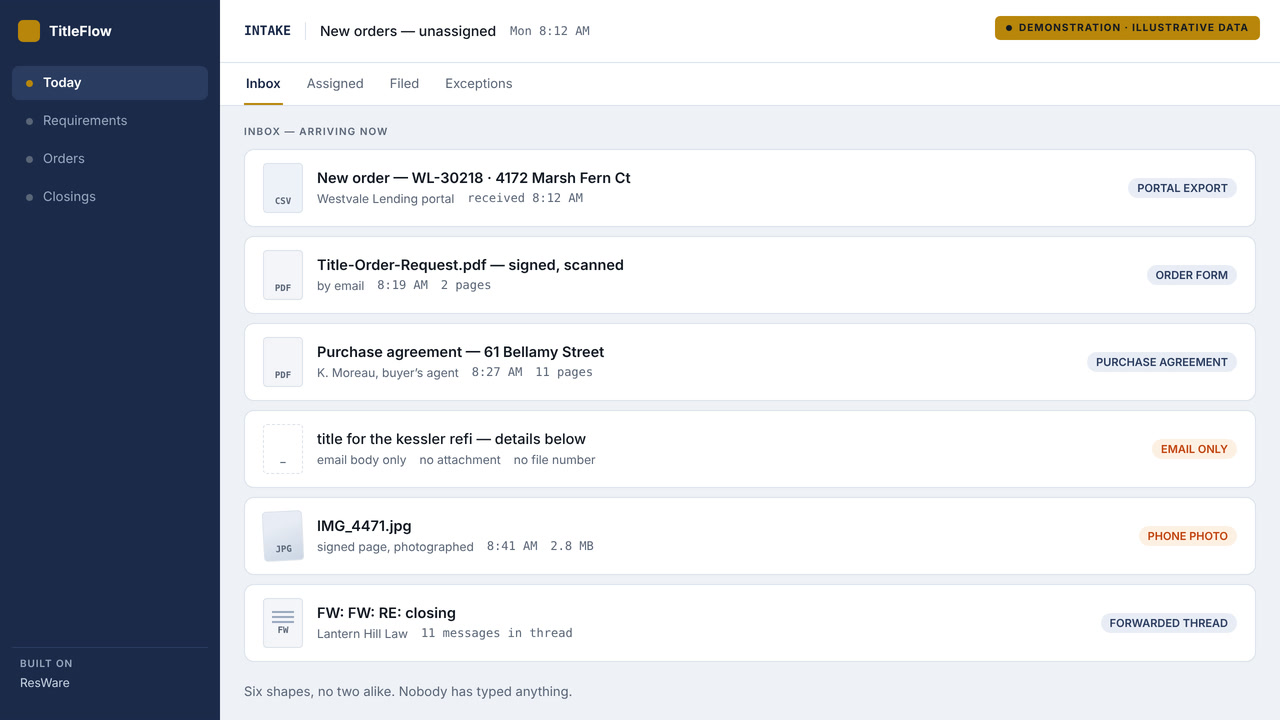
A demonstration built on illustrative data. No client files, no real people, no results claimed.
Read the transcript
Monday morning. Six new orders.
A portal export. An order form attached to an email.
A purchase agreement. And one with no attachment at all.
A photo of a signed page. A forwarded thread.
Each becomes the same structured file, in the system you already run.
Anything it can’t read cleanly goes to a person — candidates, never guesses.
Start with the free Intake Read.
How order entry automation works, mechanically
Reading: what AI extraction actually does
The reading layer is document AI — sometimes called intelligent document processing (IDP), with optical character recognition (OCR) underneath for scans and photos. Against a clean portal export it has little to do. Against a purchase agreement it is extracting parties, property, amounts, and dates from pages that were formatted for humans, not machines — and against a photographed signature page it is doing that through whatever the camera captured. The vendors are candid about the range: Pythonic’s page is built around messy inputs; XtractSol’s around structured sources first, parsing second.
Matching: new order, or a file you already have?
Extraction is half the job. The other half is deciding where the data goes: does this message open a new order, or does it belong to a file already in the system? A payoff statement, a revised contract, a signed page photographed at a closing table — each could match an existing order. Serious tools treat this as a first-class decision and surface candidates when it is uncertain, rather than silently creating duplicates or attaching documents to the wrong file.
Writing: into the system you already run
The destination is the title production system the agency already operates — not a new platform. Pythonic writes natively to SoftPro Select and ResWare through their APIs; XtractSol writes to ResWare, SoftPro, Qualia, and RamQuest; Alanna.ai lists Settlor, SoftPro, RamQuest, and ResWare among its production-system connections; Areal pushes 68+ fields into the TPS. One vendor is the structural exception: MaestroX’s OrderAid populates fields within the MaestroX platform — its own system — which is a different adoption decision than a layer that writes into yours.
What happens when an order can’t be read cleanly?
It goes to a person. This is now the category’s uniform answer, in the vendors’ own words: Pythonic routes files it can’t fully automate “to your team with data pre-filled”; XtractSol’s banner reads “AI prepares, your team decides”; Areal’s version is “Your team handles the exceptions, not the typing”; MaestroX describes “human-guided AI” with review before final submission; Dono staffs it outright — “AI runs the work, vetted title professionals verify the output.” Human review stopped being a differentiator in this category some time ago. The useful question for a buyer is narrower: what does the person receive? A bare exception flag that restarts the work, or the candidates and the reasoning, so the decision takes seconds.
Who builds title order entry automation in 2026
Seven names come up repeatedly. One of them is ours, and is labeled as such — this table states what each vendor’s own materials said on the day we checked them (November 7, 2026), and nothing more.
| Vendor | Reads | Writes to | Published figures | In their words | Offer |
|---|---|---|---|---|---|
| Pythonic | Purchase agreements, lender order forms, amendments; crossed-out words, handwritten checkboxes; email “blobs”; detects vacant land | SoftPro Select, ResWare (native APIs) | None — qualitative claims only (“industry’s #1 choice”) | Files it can’t fully automate are “routed to your team with data pre-filled” | Free trial |
| Alanna.ai | Emails, contract PDFs | Lists Settlor, SoftPro, RamQuest, ResWare | “Save up to 70% of your order entry time” — their claim, no methodology published | “Opens new orders in your title production software 24/7”; onboarding “4–6 weeks” | Demo |
| XtractSol | Gmail, Outlook, shared mailboxes; Encompass and Black Knight by API; web forms; agreements and amendments | ResWare, SoftPro, Qualia, RamQuest | “90% hands-free order entry” · “under 3 minutes” order-to-file · “99% data accuracy target” (their label) — no methodology published | “AI prepares, your team decides” | Free workflow review, then a small pilot “measured against manual entry” |
| Areal.ai | Contracts, emails, closing packages | “68+ fields” into the TPS; lists Encompass, MeridianLink, Byte, RamQuest, ResWare, SoftPro | “3 min” to open an order, “from 1–2 hours” — no methodology published | “Your team handles the exceptions, not the typing” | Demo |
| MaestroX (OrderAid) | Uploaded PDF/Word order forms; pasted email instructions | The MaestroX platform (its own) | “Return on investment of 5 to 1 or greater” — the launch article offers no supporting data | “Human-guided AI”; users “review and validate” before final submission | — |
| Dono.ai | Full search-to-commitment operations; pulls records from county sites | SoftPro, Qualia, Settlor | Extensive self-reported metrics (“4 HRS average full search,” “45% below the cost of a manual process,” “guaranteed accuracy”) — no methodology published | “AI runs the work, vetted title professionals verify the output” — a staffed service, not software alone | Demo |
| TitleFlow (WisdomStream — ours) | All six intake formats above | ResWare, Qualia, SoftPro, RamQuest, or your TPS — built on the system you already run, never a platform of ours | None, by design — we publish no accuracy rate or time-saving figure, and say why below | Anything uncertain routes to your staff with candidates and the reasoning attached — never a guess | The Intake Read: free, under a mutual NDA we sign first; one findings document back within five business days |
How much does title order entry automation cost?
Almost nobody in this category publishes pricing, so the honest answer is about models rather than numbers. Three appear: per-seat or per-order SaaS subscriptions (the common software model); staffed-service pricing, where verification labor is part of what you buy (Dono’s model); and custom builds priced to the agency’s own workflows (ours). What a buyer can insist on in every model is the same thing: a measured basis for the price — your queue, your formats, your exception rate — before a contract, not after. That is the function our free Intake Read serves, and it is why we treat “what would this save us?” as a question to answer with a measurement, not a brochure.
The percentage problem
Line the published numbers up and a pattern appears. Alanna.ai’s “up to 70%” carries no published methodology. XtractSol’s “90% hands-free” and three-minute order-to-file carry none either, and its “99%” is — by the page’s own label — a target. MaestroX’s launch article claims “5 to 1 or greater” ROI and offers no supporting data in the same breath. Meanwhile Pythonic, the vendor styling itself the industry’s #1 choice, publishes no figures at all. We read that restraint as the credible position, and we practice it: there is no accuracy rate and no time-saving figure anywhere on this page, or on our own product page. An agency evaluating this category deserves its own number, measured on its own orders — not a percentage that arrived in a marketing deck.
The part automation doesn’t reach
Two honest limits belong in any guide to this category.
The first is the seam the platforms already cover. The major production systems ship connective tissue of their own: SoftPro 360 is a business exchange where “each order will automatically transfer from your SoftPro file” to the vendors an agency orders from; Qualia positions Connect as “one secure digital transaction platform” orchestrating the closing team’s workflow. Where both sides of an order live on the same network, use the network — that movement is already clean. Order entry automation earns its keep on everything arriving from outside those rails: the rotating cast of lenders, agents, and firms on no shared platform at all, which is where the six formats come from.
The second limit is the one a skeptic would raise, and the skeptic is half right: a TPS feature labeled “automated order entry” that only works once the data is already structured hasn’t automated intake — it has automated the step after intake. The job is the mess itself: the photographed signature page, the email with no attachment and no file number, the eleven-message thread. Judge any tool in this category — ours included — by what it does with those, and by what reaches your staff when it stops: a dead end, or a decision already framed.
Evaluating an order entry vendor: the Pillar 7 lens
Since October 8, 2026, this evaluation has a shared vocabulary. ALTA Best Practices 5.0 made vendor management its own Pillar 7, and its vendor definition reaches AI tools “even if the Company engages a provider by merely sharing Company data or information” — which an order entry tool does from the first file. The diligence questions write themselves from the framework’s concerns: Where does order data go, and where is it stored? Is it used to train models? Who can access it, including sub-vendors? How are incidents escalated and disclosed? What happens to the data if the engagement ends? A vendor serious about this market should answer all of it in writing, before any real order is shared — and the engagement should start under a mutual NDA for the same reason. We’ve written a full guide to the framework itself: ALTA Best Practices 5.0 and the new Pillar 7.
As for how we build: TitleFlow is built on the title production system an agency already runs, to the same delivery standard on every build — encryption in transit and at rest, role-based access, multi-factor authentication, audit logging, and client data never used to train AI models. Documents become structured data; structured data lands in your system of record; anything uncertain routes to your own staff with candidates and the reasoning attached. The first step is the Intake Read — free, under a mutual NDA we sign first, returning one findings document within five business days, with findings stated as assumptions for you to correct, not claims.
Glossary
- Order entry — turning an incoming order request into a working file in the production system: property, parties, lender, amounts, dates, documents attached.
- TPS — title production software (ResWare, Qualia, SoftPro, RamQuest, Settlor, and peers); the system of record. For the platforms themselves, see our 2026 buyer’s guide.
- IDP / OCR — intelligent document processing and optical character recognition; the reading layer for PDFs, scans, and photos.
- Exception routing — sending an order the system can’t resolve to a person, ideally with candidates and reasoning rather than a bare flag.
- Portal export — a structured order file handed off from a lender system such as Encompass or Black Knight.
- Title commitment — the insurer’s offer to issue a policy, listing requirements and exceptions; often the first substantive document on a file.
- NPI — non-public personal information; what makes vendor diligence a regulatory matter rather than a preference.